Search This Blog

Friday, January 19, 2018

Abortion/Free Will/Religion


The anniversary of Roe v Wade is upon us, and it often invites discussions with folks who disagree with prolifers on our view of abortion.

One particular argument presented by prochoicers is this:  "God gave us all free will.  If we make abortion illegal, aren't we interfering with a woman's free will?" As presented on this prochoice website:

"We have a clearer understanding that men and women are moral agents and equipped to make decisions about even the most difficult and complex matters. We must ensure a woman can determine when and whether to have children according to her own conscience and religious beliefs and without governmental interference or coercion."

Prolife Response: We are all free moral agents, but our right to self-determination does not involve being free to inflict harm on someone else. There are thousands of laws which, in some manner, bind us from utilizing our free will to inflict harm on another. If the prochoicer is being consistent, then she would have to oppose any laws which make domestic violence illegal as well. That is, making it illegal for a husband to harm his wife would remove the husband's right to act as his own moral agent in decisions about what goes on in the privacy of his home.

All we are doing by making abortion illegal is protecting a tiny human being from being killed.  It's a matter of human rights, not human free will.

And that segues into another prochoice argument:  "I'm not Catholic, so don't inflict your religious views about abortion on me".

Prolife Response: Abortion isn't a religious issue. It's a human rights issue. That the Catholic Church has a teaching on abortion doesn't make it a religious issue, any more than feeding the poor is a religious issue because the Catholic Church has a command to feed the hungry. I don't know many prochoicers who say that the government shouldn't be involved in federal assistance programs to feed children because they're not Catholic. 

We can argue against stealing, lying, depravity, deception,  etc  etc etc without ever appealing to the Bible or to Catholic teaching.

Just like we can argue against abortion without ever once referencing religion.

Tuesday, November 21, 2017

If everything has a cause, then what caused God?

Question:  If everything has a cause, then what caused God? 

Atheists like to present their objection to Theistic arguments for God's existence in this way:

Today's argument: But All of This Had to Come From Somewhere! Otherwise known as the "First Cause" argument. "Things don't just come out of nowhere," the argument goes. "Everything that exists has a cause. Therefore, the entirety of physical existence itself had to have had a cause. Therefore, God exists."

Yeah. See, there are some big problems with that argument.

For starters: If everything has to have a cause...then what caused God?

And if God can somehow have always existed or come into being out of nothing...then why can't that be true of the universe? 


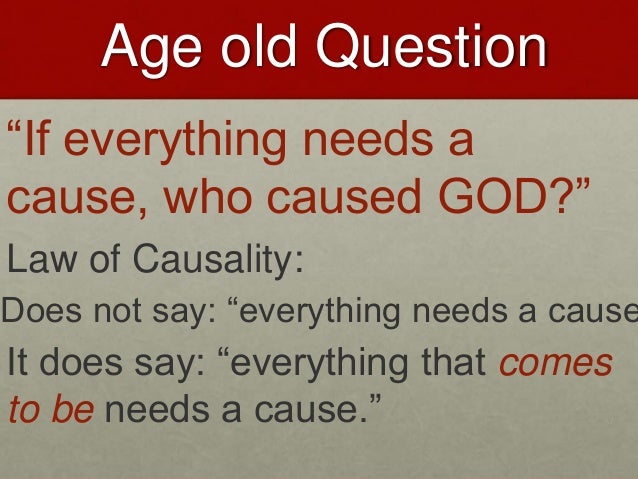
Answer: The error lies in the bolded statements above. Theists don't argue "Everything that exists has a cause".  

Rather, our argument is this: "Whatever begins to exist needs a cause".  


If something began, then we need an explanation for what caused its existence. (But if something is eternal, then logic tells us that it doesn't need a cause. And that's why we don't have to give an explanation for what caused God. God is eternal and therefore doesn't need a cause.)

Thus, if the universe began to exist, then common sense tells us it needs a cause.  

And that cause is God.

Some atheists may try to argue that the universe may have always existed--that is, it's eternal. However, the scientific community is almost unanimous in agreeing that the universe began to exist. The most accepted theory for how the universe began to exist is the Big Bang, which postulates that the universe is expanding and had a beginning in the finite past, about 14 billion years ago.

Not only is the science pretty firm on the universe beginning to exist (as opposed to always existing), philosophy and logic tells us that the universe cannot be eternal.  If the universe is eternal, and the past is infinite, we could never traverse to the point of the present.  That is, if there's an infinite number of days in the past, we can never get to today. As the 18th century Scottish Philosopher David Hume said: "An infinite number of real parts of time, passing in succession, and exhausted one after another, appears so evident a contradiction, that no man, one should think, whose judgment is not corrupted, instead of being improved, by the sciences, would ever be able to admit it." 

Finally, it should be pointed out that Theists have a incontrovertible argument when we point out:  "Something" can't come from "nothing". The universe is "something", and it requires an explanation--it didn't just pop up, magically, out of nothing of its own power. In fact, atheist Richard Dawkins called it our trump card:  “Even the last remaining trump card of the theologian, ‘Why is there something rather than nothing?,’ shrivels up before your eyes as you read these pages."   

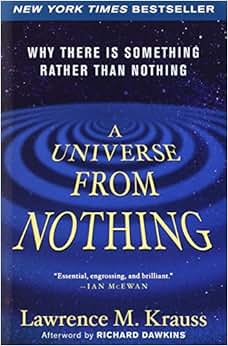
(Dawkins was writing an afterword for a book by a scientist named Lawrence Krauss called "A Universe from Nothing" in which Krauss claimed to have created "something" out of "nothing" in a laboratory setting. Krauss claims that he was able to recreate particles coming to exist out of nothing.)


Except, it turns out, that Krauss redefines "nothing" to be a low level quantum field of energy.

Reminds me of the joke:

God was once approached by a scientist who said, “Listen God, we’ve decided we don’t need you anymore. These days we can clone people, transplant organs and do all sorts of things that used to be considered miraculous.”
God replied, “Don’t need me huh? How about we put your theory to the test. Why don’t we have a competition to see who can make a human being, say, a male human being.”
The scientist agrees, so God declares they should do it like he did in the good old days when he created Adam.
“Fine” says the scientist as he bends down to scoop up a handful of dirt.”
“Whoa!” says God, shaking his head in disapproval. “Not so fast. You get your own dirt.”

Friday, November 10, 2017

Faith is NOT "Believing Without Evidence"

I just saw this on the internet:

I believe something even though
there is no evidence to support it.”


And while I couldn't find any primary sources to confirm actor and creationist Kirk Cameron actually said this, (as opposed to someone falsely attributing this to him...), there are still a lot of Christians who do profess that faith is indeed "Believing Without Evidence".

In fact, Bishop Robert Barron was invited to speak at Facebook Headquarters, and relates a story about hearing Evangelical Ralph Reed of the Christian Coalition confirm on TV that, yes, he (Ralph Reed) believes "without evidence".  

Bishop Barron amusingly reports that he yelled at the TV "Nooooo!" and almost threw the remote at the screen.   Bishop Barron wants to affirm that this is NOT faith, at least, not faith as Catholicism understands it.

Credulity, gullibility, accepting any old nonsense, believing something in direct contrast to evidence...Bishop Barron says, "We are against that!"

We take the evidence for God, including philosophical arguments (how can the universe begin to exist without a Creator?), and the evidence for Christianity, including the Gospels, the New Testament texts, the testimony of the first witnesses to Christ, the Sacred Tradition of the Apostles and their successors, our bishops, and examine, digest, and consider their rationality, reject anything that contradicts reason (there is nothing, incidentally, which Catholicism professes with is contrary to science, reason, logic).... and move forward towards growth in our Faith.

Sunday, October 1, 2017

"Essentials of Christianity" and refuting the "But Catholics disagree too!"

Thanks to the Protestant Reformation, Christianity has now grown into a behemoth of tens of thousands of differing Christian denominations.  When one divorces himself from obedience to a central teaching authority, or magisterium, one opens himself up to being his own arbiter of what it means to be a Christian.  "I don't believe [A] even though that's what my church teaches" leads to a separation from this particular body of beliefs...and one cannot then deny another fellow brother in Christ the right to say, "Yeah, well I don't believe [B] even though you believe that's what is required to be a good Christian".

It's just what the devil ordered, IMHO. Chaos and confusion regarding what it means to be a Christian. Separation and disunity on doctrine.   Is baptism required for salvation?  Is Saturday the Lord's Day? Can we lose our salvation? Are we going to be Raptured? Is God a Trinity? 

Are the above "essential" to being a Christian? Since the Bible doesn't tell us what's an "essential" doctrine, it depends upon which Christian you ask.

It will be posited, however, that Catholicism is not immune to these divergent theological opinions also.  The "Tu Quoque" ("but you do it, too!) argument is presented.  

And they are correct:  there is indeed disagreement among Catholic circles as well.  Should girls be permitted to be altar servers? How can All Saints Day be a Holy Day of Obligation in one diocese but not in another diocese? (This is based on the bishop's discretion). Why do some diocese get a dispensation during Lent for St. Patrick's Day to eat meat? (Also based on the local ordinary's discernment). Which is better--that Latin Mass or Mass in the vernacular?

Apologist Jimmy Akin gives a response:  "A number of points may be made: First, Catholicism has a functioning magisterium that can decide that these matters are not essential differences. Second, the relevant schools adhere to the teachings of the magisterium and, if their views were reprobated, would accept the results (or cease to be faithful Catholics). Third, the differences between Catholic schools of thought have nowhere near the magnitude of the difference among Protestant schools. Compared to the differences among Protestant groups, differences among orthodox Catholic groups are trivial. Finally, the fact that the Catholic Church has a magisterium means that there can be—and on the most important theological matters there is—an official Catholic position. There is no parallel standard in Protestant circles that can speak for Protestantism."

And a Protestant may also offer this objection:  you all have your own problems in your Catholic churches. Look at all the Catholics who disagree with your Church on matters like abortion, homosexuality, women's ordination. 

We respond: this is not an equivalent comparison. Catholics who disagree with Catholic teaching are being "bad" Catholics. However, Protestants, when they diverge from their own church's doctrines, are simply being "good" Protestants...following their own personal, private interpretations of the Word of God, as has been permitted and celebrated by Protestantism since the Protestant Reformation.